
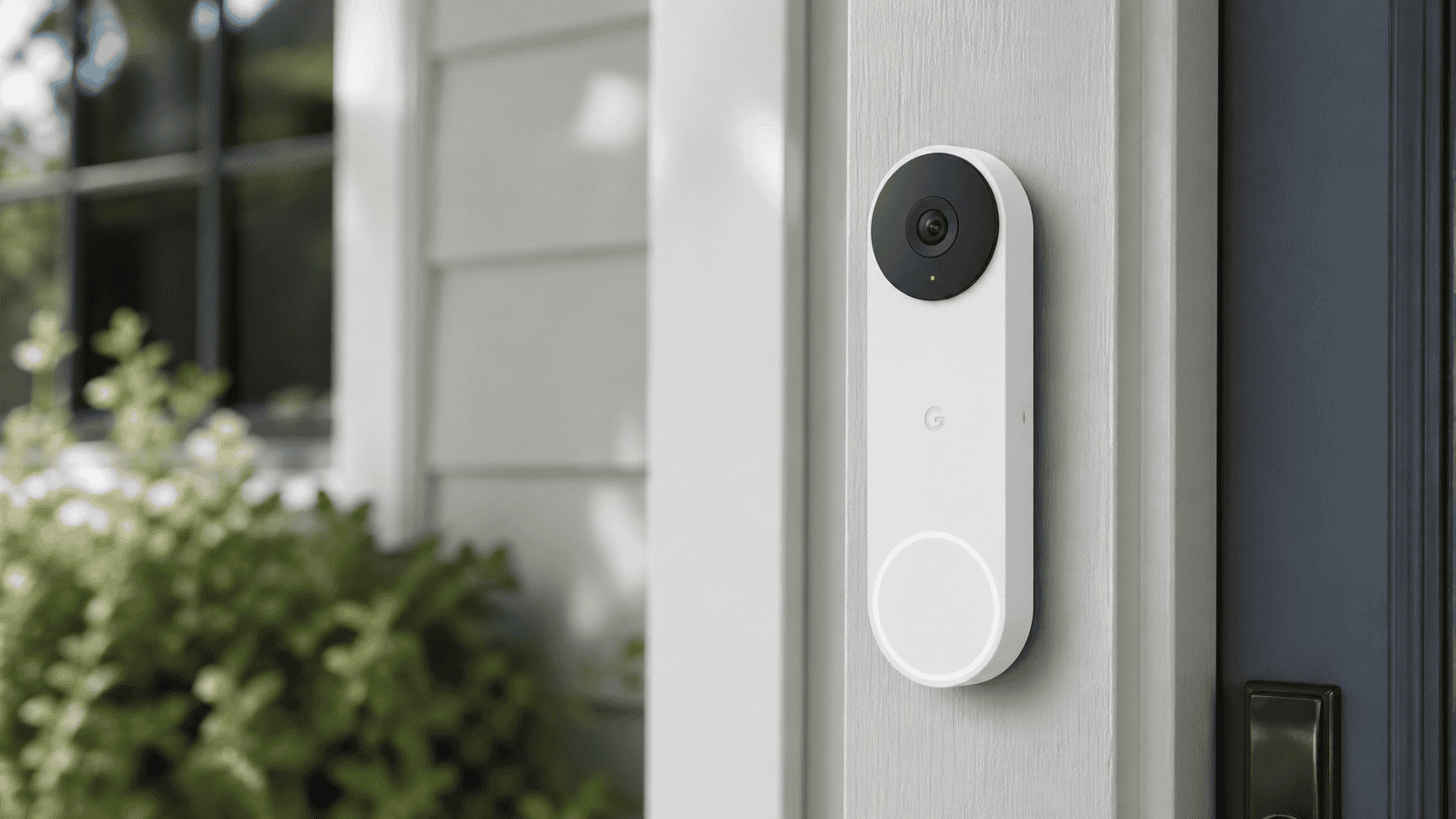
The Google Nest Doorbell (Battery) occupies an unusual position in the Nest lineup in 2026. It launched in 2021 as Google’s first battery-powered doorbell, and it remains on sale today — but it has not received a hardware refresh while its wired sibling, the Nest Doorbell Wired, has been updated twice. The result is a camera that still delivers Google’s excellent AI detection and Google Home integration, but at a resolution that is noticeably behind where the market has moved.
Whether that matters for your situation depends on what you are buying it for. This review covers the specs honestly, where the camera performs well, where it shows its age, and who should still consider it in 2026.
A Note on Naming
Google’s doorbell naming conventions cause consistent confusion, so it is worth clarifying upfront. The Nest Doorbell (Battery) — this camera — launched in 2021 and has not been updated since. The Nest Doorbell (Wired, 2nd Gen) launched alongside it as a wired-only sibling. Google has since released a Nest Doorbell (Wired, 3rd Gen) with 2K HDR resolution, which is the newer and more capable wired option. There is no battery-powered 3rd Gen equivalent. When you see references to the “new Nest Doorbell” in 2025 and 2026 coverage, they refer to the wired 3rd Gen, not this camera.
Specs at a Glance
The Nest Doorbell (Battery) records at 960 x 1280 in a 3:4 portrait aspect ratio at 30 frames per second. The sensor is a 1.3MP 1/3-inch unit. Field of view is 145 degrees diagonal. Night vision uses four 850nm infrared LEDs with a stated range of up to 10 feet. The 6,000mAh internal battery delivers up to six months of charge under typical use. The camera is IP54 rated for weather resistance. It connects over 802.11a/b/g/n Wi-Fi on both 2.4GHz and 5GHz bands, plus Bluetooth for initial setup. It measures 6.3 x 1.8 x 0.95 inches and weighs 338 grams. It is available in Snow, Linen, Ash, and Ivy. It cannot record 24/7 continuously in either battery or wired mode. Storage requires a Google Home app account; three hours of event history is free, with extended history requiring a Nest Aware subscription.
Design and Build
The Nest Doorbell (Battery) is the most attractive doorbell camera in this review series. Its slim rectangular form, matte finish, and flush button give it an understated quality that most competitors do not match. The four color options — particularly Ivy and Ash — blend into painted door frames far more naturally than Ring’s or Eufy’s predominantly dark plastic housings.
The camera is slightly larger than the wired version to accommodate the internal battery, but the difference is minimal in practice and not visible once mounted. Installation uses a base plate that mounts to the wall or door frame with two screws, and the camera snaps onto the plate with an audible click. Removal requires the included release tool — a small key-shaped implement — which is more secure than a simple pinhole but more annoying if you misplace it. Ring uses a pinhole system that accepts any straightened paperclip, which is a more practical approach.
Build quality is premium by doorbell camera standards. The 45 percent recycled plastic construction is a sustainability detail worth noting for buyers who factor that into purchasing decisions. The IP54 weather rating is a genuine limitation relative to competitors: IP65-rated cameras like the SimpliSafe Video Doorbell Pro handle direct water jets, while IP54 covers splashing from any direction but not sustained water exposure. For most North American climates and typical porch installations, IP54 is sufficient. For doorbell mounts exposed to sustained driving rain, it is worth knowing.
Video Quality
The 960 x 1280 resolution is the most significant limitation to address honestly. At a pixel count that falls short of 1080p on the horizontal axis, the Nest Doorbell (Battery) is behind most of its competition on paper in 2026. Competing cameras from Ring, Eufy, and Arlo in the same price range record at 1536p, 2K, or higher.
In practice, the gap between this camera and 1080p competitors is visible but not dramatic in good lighting. The 3:4 portrait aspect ratio is the camera’s saving grace: it captures visitors from head to toe, including packages left at the base of the door, in a frame that feels natural and complete. Daytime video at normal doorbell distances — a visitor standing three to six feet away — is clear enough to identify faces, read expressions, and see what someone is carrying. The wider the shot needs to be, the more the lower resolution starts to show.
Dynamic range handling is where the camera falls noticeably short. In high-contrast situations — a visitor backlit by afternoon sun, or a porch with a bright sky behind it — the image compresses shadow detail significantly. Independent testing found it produced only partial dynamic range recovery in bright background conditions, resulting in underexposed foreground subjects. Competitors with HDR processing, including the Nest Doorbell Wired 3rd Gen and the Arlo Video Doorbell 2K, handle these scenarios more successfully.
Night vision is infrared black and white with a 10-foot range. At short distances in darkness, faces are identifiable. Beyond 10 feet, detail degrades quickly. There is no color night vision in any mode, which is a meaningful gap compared to cameras like the Eufy E340 and the Ring Wired Doorbell Pro that produce color footage after dark.
Motion Detection and AI
This is where the Nest Doorbell (Battery) genuinely earns its price. The on-device AI detection is the best in the battery doorbell category by a meaningful margin. In independent testing across multiple review sources, object detection accuracy reached 100 percent for people, animals, vehicles, and packages. False positive rates in windy conditions — where many PIR-based cameras fire on foliage — were effectively zero. That is not a common result for a doorbell camera.
Notifications arrive within one to two seconds of a motion event, which is competitive with the fastest cameras in this roundup and significantly faster than some competitors. Activity zones let you focus detection on your property and exclude street traffic, which reduces nuisance alerts substantially once configured. The zones are drawn visually in the Google Home app and are easy to adjust.
The detection AI distinguishes between people, packages, animals, and vehicles at no cost. This is a meaningful differentiator against Ring, which locks person-specific detection behind a Protect subscription, and Arlo, which requires Arlo Secure for smart alert classification. Getting AI-filtered alerts without paying anything ongoing is one of the Nest platform’s strongest arguments.
Subscription and Storage
Understanding Nest’s storage model requires distinguishing between what is free and what requires payment. Without any subscription, the camera provides live view, real-time motion alerts with AI classification, and three hours of rolling event history. Three hours is enough to review what happened at your door earlier in the afternoon; it is not enough to go back and check footage from yesterday morning.
Google Home Premium, formerly called Nest Aware, costs approximately $8 per month or $80 per year and extends event history to 30 days across all Nest cameras on one account. Nest Aware Plus at $15 per month or $150 per year extends to 60 days of event history. Neither tier enables 24/7 continuous recording for this camera — that capability is structurally unavailable on the battery model regardless of subscription level, and is one of the key differences between this camera and the wired 3rd Gen.
Facial recognition, which assigns names to recognized faces and sends personalized alerts such as “Jordan is at the front door,” is unlocked with Google Home Premium. It runs on-device and does not require any additional configuration beyond tagging faces in the app during initial setup. This is a feature that costs extra on Ring and does not exist at all on Eufy’s base models. For households that want personalized detection, it is a genuine Nest platform advantage.
One storage caveat worth knowing: the camera stores up to 60 minutes of footage locally when Wi-Fi goes down or power is interrupted. That local buffer uploads to the cloud when connectivity is restored, which protects event footage during brief outages. There is no persistent local storage option — no microSD slot, no NVR compatibility.
Installation
Installation is the simplest of any camera in this review series. Mount the base plate, snap the camera into place, open the Google Home app, scan the QR code on the back of the unit, and follow the on-screen steps. The entire process takes under fifteen minutes for battery mode. Wired installation adds the step of connecting two low-voltage wires at the back of the base plate, which takes an additional five to ten minutes and activates your existing wired chime.
One important nuance on chime behavior: in battery-only mode, the existing wired chime does not ring when the doorbell is pressed. Alerts go to your phone and to any Google Assistant-enabled speakers or displays in your home. If you want your existing chime to ring, you need to connect the doorbell to the wiring, even if you continue to use the battery as the primary power source. This distinction catches some buyers off guard and is worth confirming before you commit to battery-only installation.
The release tool requirement for removal is the one friction point in an otherwise clean installation experience. Google includes the tool in the box, but it is small and easy to misplace. Taping it to the inside of the chime box or keeping it with installation documentation is worth doing on day one.
Battery Life
The 6,000mAh internal battery is rated for up to six months between charges under typical use. In real-world testing across multiple independent reviews, results ranged from two to five months depending on traffic volume, temperature, and detection sensitivity settings. Higher-traffic doors and colder climates drain the battery faster. One 30-day test found roughly 42 percent of battery consumed, suggesting a realistic full-charge lifespan closer to two to three months under normal suburban use.
Charging requires removing the camera from the mount using the release tool, taking it inside, and connecting the included USB-C cable. Full charge takes approximately five hours. Google’s documentation notes that wired installation below 0 degrees Celsius still requires periodic indoor charging, which limits the convenience advantage of wired power in very cold climates.
Google Home Integration
For households already using Google Home, the integration is the most seamless available in any doorbell camera. Live view surfaces automatically on Nest Hub and Nest Hub Max displays when the doorbell is pressed. The Google Home app’s Automations support over forty trigger conditions, and a doorbell press can trigger lights, locks, speakers, or any other compatible device. Matter support is rolling out across Nest cameras, which expands cross-platform compatibility over time.
The Google Home app rates 4.4 on iOS and 4.1 on Google Play, with setup described as straightforward across multiple independent reviews. The app’s interface for reviewing event history, setting detection zones, and managing multiple cameras on one account is clean and well-organized.
Apple HomeKit is not supported. For iPhone-first households that want HomeKit integration, the Arlo Video Doorbell 2K is the right alternative.
How It Compares to the Nest Doorbell Wired (3rd Gen)
The most common question buyers have about this camera is whether they should choose it over the Nest Doorbell Wired 3rd Gen. The answer depends almost entirely on whether your home has existing doorbell wiring.
The Wired 3rd Gen records in 2K HDR — a significant resolution upgrade over the battery model’s 960 x 1280. It handles high-contrast and low-light conditions measurably better. It supports 24/7 continuous recording with a Nest Aware Plus subscription. And it never needs charging because it draws continuous power from the transformer.
The battery model’s advantages are flexibility and reach. It works in any home regardless of wiring, installs without electrical connections, and is genuinely portable — relevant for renters or anyone who wants to take the camera to a new address. If your home lacks doorbell wiring and you want to stay in the Google ecosystem, the battery model is the only Nest option available.
The Bottom Line
The Google Nest Doorbell (Battery) is a camera with one exceptional strength and one honest weakness. The AI detection accuracy and free smart alert classification are the best in the battery-powered category, and the Google Home integration is the most complete available in any doorbell. The 960 x 1280 resolution and IP54 rating are real limitations in a market that has largely moved to 2K and higher, and the absence of color night vision or 24/7 recording puts it behind competitors at a similar price point on pure specifications.
For Google Home households without existing doorbell wiring, it remains the right choice in 2026 — the ecosystem integration and detection accuracy justify the resolution trade-off if the Nest platform is what you want. For buyers without a Google ecosystem preference, the Eufy S220 or the Arlo Video Doorbell 2K deliver higher resolution and comparable or better features at similar prices with no ecosystem dependency.
