
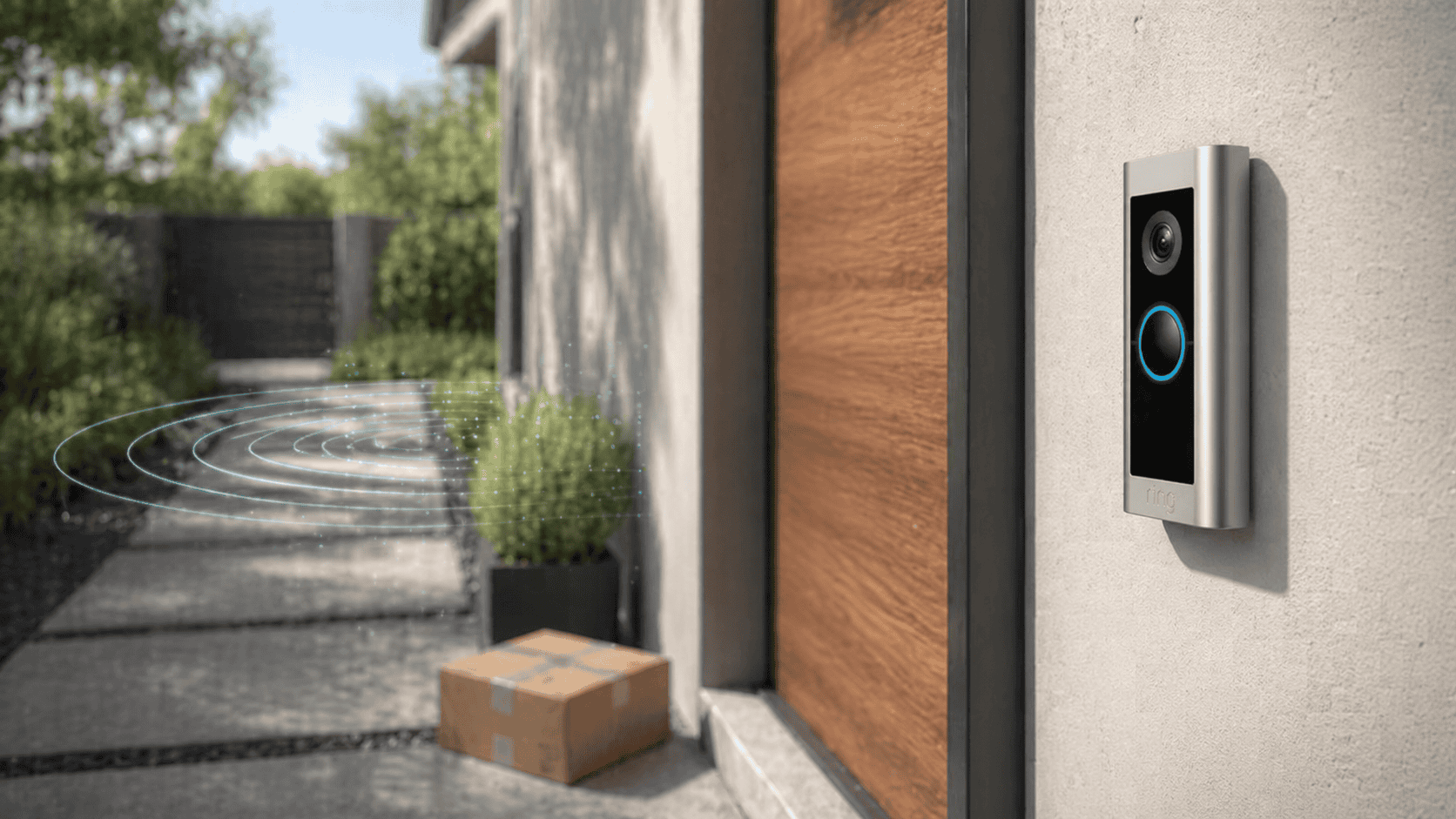
The Ring Video Doorbell Pro 2 launched in 2021 as Ring’s flagship wired doorbell and has since been renamed the Ring Wired Doorbell Pro — same hardware, same features, updated product name. Ring confirmed the renaming in 2024 was purely a branding decision and made no changes to performance, accessories compatibility, or firmware support. You may find it listed under either name depending on the retailer.
It remains an actively sold and supported camera, though Ring has since released the Ring Wired Doorbell Pro 3rd Gen with 4K resolution at a higher price point, which positions the Pro 2 / Wired Doorbell Pro as the mid-tier wired option in their current lineup at $249. For buyers who want Ring’s wired performance without paying for 4K, this is the camera to evaluate.
Specs at a Glance
The Ring Video Doorbell Pro 2 records at 1536p in a 1:1 square aspect ratio with a 150-degree field of view both horizontally and vertically. It requires hardwiring to an existing 16 to 24V AC doorbell transformer — there is no battery. Connectivity covers both 2.4GHz and 5GHz Wi-Fi via 802.11 b/g/n/ac. The camera is IP55 rated for weather resistance. It includes a corner kit in the box, works with existing doorbell chimes using the included Pro Power Kit, and integrates with Alexa and Google Assistant. Apple HomeKit is not supported. Motion detection uses radar-based 3D sensing. Pre-roll captures six seconds of footage before a motion event triggers. Storage requires a Ring Protect subscription starting at $4.99 per month. Dimensions are 114 x 49 x 22mm, making it compact enough for most standard door frames.
Design and Build
The Pro 2 maintains Ring’s familiar rectangular silhouette — camera in the upper half, illuminated button below — in a slimmer profile than Ring’s battery-powered models because there is no battery pack to accommodate. The compact dimensions at just under 4.5 inches tall mean it fits on narrow door frames without issue, including in situations where wider battery models would overhang or sit awkwardly against the trim.
The unit ships with a Satin Nickel faceplate and ships eligibility for a free additional faceplate in any of 16 color options after registration, a nice touch that lets buyers match the doorbell to their door hardware or exterior paint. The original Pro came with four colors in the box, so this is a slight step back in the unboxing experience, but the expanded color selection and free additional faceplate more than compensate.
A corner kit is included in the box, which allows angling the camera left or right for installations where the door frame does not face the approach path directly. This is a useful inclusion that Ring omits on its entry-level models. Two security screws at the base require the included security screwdriver to remove, which is a meaningful anti-theft measure for a camera at this price point.
Build quality is premium by Ring standards. The casing has a more refined, slightly elevated feel compared to Ring’s budget models, and the backplate functions as a heatsink — a practical engineering detail that helps with heat management during continuous operation.
Video Quality
The 1536p square aspect ratio is the most significant feature upgrade over Ring’s older 1080p widescreen models and the main reason to choose this camera over Ring’s entry-level offerings. The square frame captures the full scene from head to toe: faces at speaking height and packages sitting at the base of the door appear in the same shot without compromising either. Buyers who switched from the original Ring Pro specifically cited this as the most immediately noticeable improvement in day-to-day use.
Daytime video is sharp with accurate color reproduction and performs well in both bright sunlight and overcast conditions. HDR is available via the app and improves dynamic range in high-contrast situations such as a bright sky behind a shadowed visitor, though it defaults to off and must be enabled manually.
Night vision on the Pro 2 is colorized rather than full-color. Ring uses ambient light in the scene to produce a simulated color tint — visitors appear in muted, plausible colors rather than stark infrared white. The practical result is better than pure infrared in partially lit environments such as a lit porch or a streetlit walkway, but it falls short of the full-color spotlight output found on cameras like the Eufy E340. In complete darkness, the colorization fades and the footage becomes effectively monochrome. Buyers who need vivid color in complete darkness should factor this in.
3D Motion Detection and Bird’s Eye View
The radar-based 3D Motion Detection is the Pro 2’s most distinctive feature and the one that most clearly separates it from cameras using standard PIR sensors. The radar measures not just whether motion occurred but where it originated and how far away it was. Setup in the app involves drawing zones over a live aerial map view of your property, allowing you to define exactly which areas should trigger alerts. This means you can set the driveway to trigger without including the sidewalk, or isolate the front path while ignoring the street.
In real-world testing across multiple reviews, the result is meaningfully fewer false alerts compared to PIR-based cameras. Passing vehicles, blowing trees, and distant pedestrians can all be excluded with enough precision that the alert rate becomes genuinely manageable rather than requiring constant sensitivity adjustment. This is not a subtle difference. Buyers who have lived with a PIR camera on a busy street will notice the reduction in nuisance alerts immediately.
Bird’s Eye View generates a top-down visual map of a visitor’s path across your property from when they entered the frame to when they left. It is displayed alongside the motion event in the app and adds useful context for understanding how someone approached the door, whether they lingered near the entrance, and which direction they came from. It is a feature that sounds like a novelty but proves practically useful, particularly for monitoring package deliveries or reviewing suspicious activity.
Pre-roll captures the six seconds before a motion event fully triggers, which addresses the most common complaint about motion-triggered cameras: by the time the alert fires and you open the app, the person has already passed. With pre-roll, the footage starts a few seconds earlier and typically shows the full approach.
Audio
Two-way audio on the Pro 2 uses Ring’s Audio+ system, which delivers noticeably clearer conversation than the standard microphone and speaker setups on Ring’s entry-level models. Echo cancellation is more effective, background noise handling is improved, and voices at a normal speaking distance come through without the dropout or distortion that can appear on cheaper cameras. Multiple independent reviewers noted audio quality as a standout compared to previous Ring models.
Alexa Greetings is a subscription feature that instructs Alexa to speak to a visitor automatically when you do not respond to a doorbell notification within a set time. Alexa can greet the visitor, accept a delivery instruction, or take a message. This feature is US-only and requires an active Ring Protect subscription. It is a genuinely useful automation for households with frequent deliveries or callers, and one of the more substantive Alexa integrations Ring has built into any of its cameras.
Installation
Installation requires existing low-voltage doorbell wiring at the front door. The included Pro Power Kit installs inside your existing chime box and ensures enough power is delivered to run the camera continuously. Ring includes a full tool kit in the box: mounting screws, a drill bit, a wedge adapter, the security screwdriver, and clear app-guided installation instructions.
The chime wiring step is where most users report brief confusion. The Pro Power Kit involves connecting wires at the chime terminal, and the correct wire assignment depends on your existing chime model. Ring’s in-app installation guide walks through the most common configurations, and the documentation is more thorough than what competitors typically include. First-time hardwired installers should budget around forty-five minutes rather than fifteen.
Once installed, the camera draws continuous power from the transformer and requires no further maintenance. There is no battery to charge or monitor, which is the core practical advantage of a wired model over any battery equivalent. The Pro 2 also supports 5GHz Wi-Fi, which is meaningfully better than the 2.4GHz-only radios found in Ring’s entry-level models and reduces interference in homes with congested wireless networks.
The Subscription Question
Like every Ring camera, the Pro 2 requires a Ring Protect subscription to store recorded video. Live view and real-time doorbell notifications are free. Pre-roll footage, video history, AI-powered descriptive alerts, Alexa Greetings, Familiar Faces recognition, and the ability to review any recorded event all require the Basic plan at $4.99 per month per camera, or the Ring Home multi-device plan at $9.99 per month.
For a $249 camera, the mandatory subscription to access most of its features is a legitimate criticism. The 3D Motion Detection and Bird’s Eye View work without a subscription, but pre-roll, the feature most buyers cite as a key purchase reason, does not. The total two-year cost of ownership at the Basic plan level is $249 for the hardware plus $120 in subscription fees, or $369. At that price, alternatives with no subscription, such as the Reolink wired doorbell with local microSD storage, become meaningfully competitive.
There is no local storage option. No microSD slot, no NVR compatibility for on-device recording. All footage is cloud-only, which means subscription costs are structural rather than optional for anyone who wants a video history.
Privacy and Security Context
Ring is an Amazon subsidiary and has faced scrutiny over its data sharing practices and law enforcement cooperation. Ring’s history includes a period during which the company partnered with police departments to share footage through its Neighbors app, and a 2019 data breach that exposed user credentials. Ring has since made changes including end-to-end encryption for video (opt-in), mandatory two-factor authentication, and a Law Enforcement Request Transparency policy. Buyers who prioritize privacy should review Ring’s current privacy statement and enable available encryption settings before installation.
This context does not make the Pro 2 a poor camera. It does mean that buyers with strong privacy concerns should evaluate the trade-offs carefully and consider whether a locally-stored alternative would better serve their household.
How It Compares Within Ring’s Lineup
The Pro 2 / Wired Doorbell Pro sits between the Ring Wired Doorbell Plus (2K, $179.99) and the Ring Wired Doorbell Pro 3rd Gen (4K, $249.99) in Ring’s current wired lineup. Relative to the Plus, the Pro 2 adds 3D radar motion detection, Bird’s Eye View, pre-roll, and Audio+. Relative to the 3rd Gen Pro, the Pro 2 gives up 4K resolution and the Alexa+ on-the-fly response features, but is often available at a lower effective price at retail.
For buyers who want Ring’s ecosystem and wired reliability, the Pro 2 hits the most sensible feature-to-price balance in the lineup. The 3rd Gen’s 4K upgrade is meaningful for buyers who routinely zoom in on footage to read labels or identify faces at distance. For most front-door monitoring use cases, 1536p in the square aspect ratio is sufficient.
The Bottom Line
The Ring Video Doorbell Pro 2 is a strong, well-engineered wired doorbell camera with a genuinely useful feature set. The square 1536p aspect ratio, radar-based 3D Motion Detection, Bird’s Eye View, pre-roll, and Audio+ together deliver a meaningfully more capable experience than Ring’s entry-level models. Installation is involved but well-documented, and continuous wired power eliminates the battery management that affects Ring’s other models.
The mandatory subscription for most of its best features and the absence of local storage are real structural limitations that add $120 or more to the two-year cost. Buyers already in the Ring ecosystem who value the platform’s reliability and integration are the natural fit for this camera. Buyers who want to avoid cloud dependency entirely will find better options elsewhere.
