
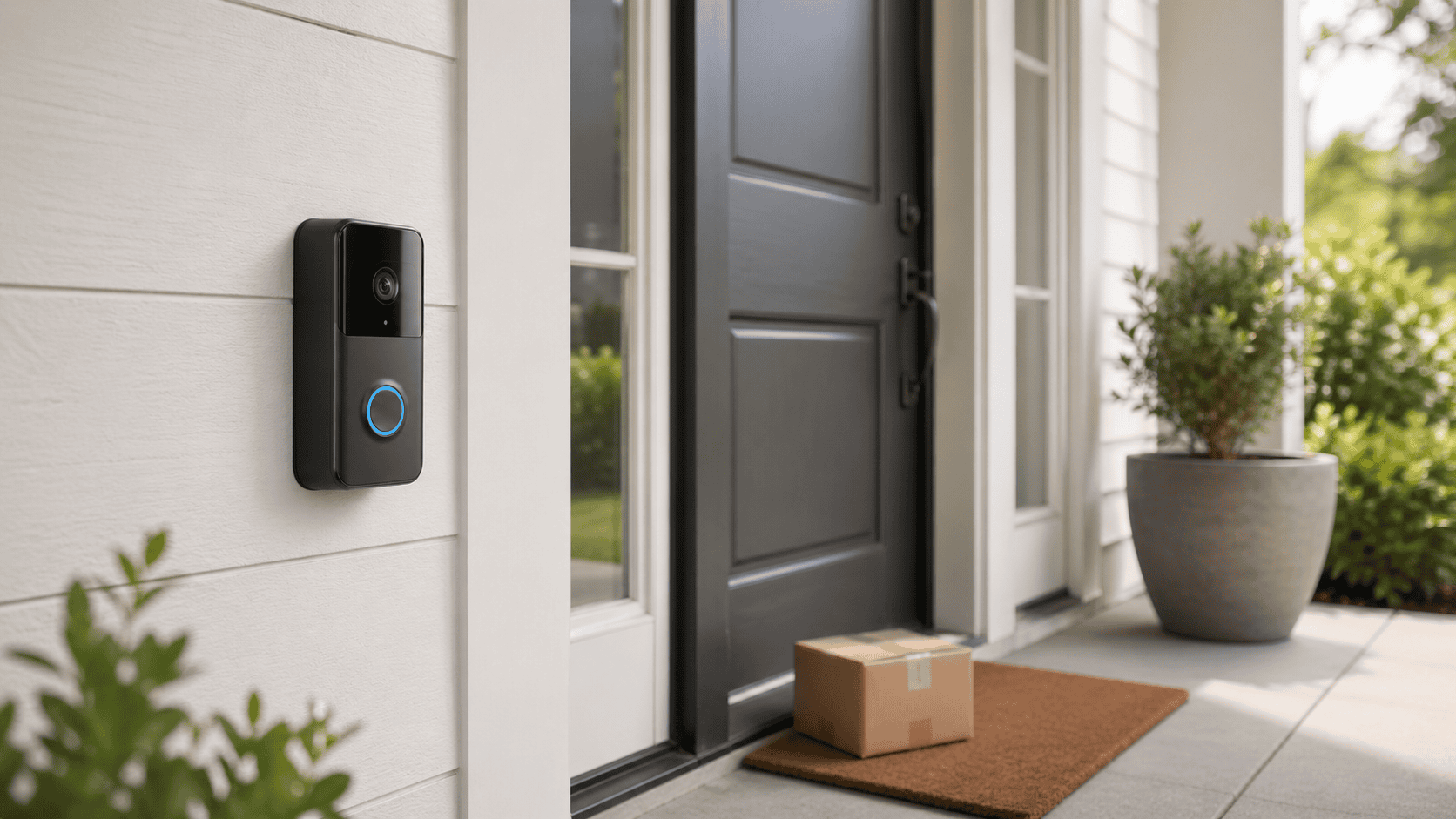
Wireless doorbell cameras are the right choice for most buyers. No electrician, no drilling into your home’s wiring, and in most cases no more than 20 minutes to install. If you’re renting, if your home has no existing doorbell wiring, or if you simply want the simplest possible setup, a battery-powered doorbell camera delivers everything a wired model does — with far less hassle.
We’ve researched and tested the top wireless doorbell cameras on the market and ranked them below based on video quality, battery life, motion detection accuracy, and total cost including subscriptions.
Quick Picks
| Camera | Best For | Battery Life | Price |
|---|---|---|---|
| Ring Battery Doorbell Plus | Best overall | 3 to 6 months | ~$100 |
| Google Nest Doorbell (Battery) | Smart home users | 1 to 6 months | ~$180 |
| Eufy Video Doorbell S220 | No subscription | Up to 6 months | ~$100 |
| Arlo Essential Wire-Free | Widest field of view | Up to 6 months | ~$150 |
| Blink Video Doorbell | Budget pick | Up to 2 years | ~$50 |
Our Top Picks
Battery-powered doorbell cameras have closed the gap on wired models significantly. The five picks below cover every major buyer type — from the renter who wants a 15-minute install to the homeowner who refuses to pay a monthly fee.
Ring Battery Doorbell Plus — Best Overall Wireless Doorbell
The Ring Battery Doorbell Plus is the easiest wireless doorbell camera to recommend. Installation takes about 15 minutes: mount the bracket, snap the doorbell in, connect through the Ring app. No wiring, no tools beyond a screwdriver, and the included adhesive wedge kit means you don’t even need to drill in some cases.
Video quality is strong at 1536p with a head-to-toe aspect ratio that captures packages on your front step. Motion detection is reliable and the Ring app is polished. Battery life runs three to six months under moderate use, and a quick-release design makes the battery easy to swap out or charge indoors. Ring sells a spare battery ($30) so you can hot-swap without any downtime.
The subscription caveat applies here as it does across the Ring lineup: video history beyond live view requires Ring Protect at $5 per month. For most buyers that’s a reasonable cost, but if subscriptions are a dealbreaker, look at the Eufy S220 below.
Who it’s for: First-time buyers, renters, anyone who wants a proven, widely supported system with a best-in-class app.
Specs at a glance:
- Resolution: 1536p Head-to-Toe
- Battery life: 3 to 6 months (varies with activity level)
- Field of view: 150° horizontal / 150° vertical
- Smart home: Alexa, Ring app
- Subscription: Optional (Ring Protect from $5/mo for video history)
Google Nest Doorbell (Battery) — Best for Smart Home Users
The Google Nest Doorbell (Battery) is the most intelligent wireless doorbell camera on this list. Its AI goes well beyond basic motion detection — it distinguishes between people, packages, animals, and vehicles, and provides contextual alerts that tell you what it saw, not just that something moved. During testing it correctly identified a package arrival and flagged an unfamiliar visitor within seconds.
Battery life is the trade-off. Google rates it at one to six months depending on settings, and in high-traffic locations it drains faster than Ring or Eufy. Switching to the wired version eliminates that issue entirely, but the battery model remains a strong wireless pick for homeowners who want smarter alerts without managing a complex setup. Nest Aware ($6 per month) unlocks video history and familiar face detection.
Who it’s for: Google Home households, anyone who wants smart contextual alerts, buyers willing to trade some battery life for superior AI detection.
Specs at a glance:
- Resolution: 960p HDR
- Battery life: 1 to 6 months (highly activity-dependent)
- Field of view: 145°
- Smart home: Google Home, Google Assistant, Chromecast
- Subscription: Optional (Nest Aware from $6/mo)
Eufy Video Doorbell S220 — Best Wireless Option Without a Subscription
The Eufy S220 is the answer for buyers who want wireless convenience and zero ongoing costs. All footage is stored locally on the included HomeBase 2 unit, which sits inside your home. The on-device AI handles person and package detection without routing anything through a cloud server, so you get smart alerts at no extra charge.
Video quality is 2K HDR, which is sharper than Ring and Nest’s wireless offerings. False alert rates are low and the motion detection is genuinely accurate. The app is functional though not as polished as Ring’s, and you’ll want to keep the HomeBase in a secure location — if it’s stolen, your local footage goes with it. Optional cloud backup is available for those who want belt-and-suspenders coverage.
Who it’s for: Privacy-conscious buyers, anyone frustrated by monthly fees, homeowners who want sharp video with zero ongoing cost.
Specs at a glance:
- Resolution: 2K HDR
- Battery life: Up to 6 months
- Field of view: 135°
- Smart home: Google Assistant, Amazon Alexa
- Subscription: Never required (optional cloud storage available)
Arlo Essential Wire-Free — Best Field of View
The Arlo Essential Wire-Free delivers the widest field of view of any wireless doorbell camera in this roundup. Its 180-degree lens with a 1:1 square aspect ratio captures visitors from head to toe and sees further left and right than competing models — particularly useful for wide entryways, porches, or corner placements where blind spots are a concern.
Video quality is solid at 1080p HDR with good night vision performance. A built-in siren is a genuine bonus — it can be triggered manually from the app or set to activate automatically, which most wireless doorbell cameras don’t offer. Battery life is rated at up to six months, though real-world performance is closer to two to four months on active front doors. The Arlo Secure subscription ($8 per month) is required to unlock smart AI alerts beyond basic motion detection.
Who it’s for: Buyers who need maximum coverage at a wide or exposed entryway, anyone who wants a built-in siren on a wireless camera.
Specs at a glance:
- Resolution: 1080p HDR
- Battery life: Up to 6 months (typically 2 to 4 months in active use)
- Field of view: 180°
- Smart home: Alexa (Google Assistant not supported)
- Subscription: Free basic tier; Arlo Secure from $8/mo for AI alerts
Blink Video Doorbell — Best Budget Wireless Doorbell
The Blink Video Doorbell is the most affordable wireless doorbell camera worth buying. At around $50 it delivers 1080p HD video, two-way audio, motion alerts, and an exceptional battery life of up to two years on two AA lithium batteries. There’s nothing else on the market that comes close on battery longevity, which makes it a strong option for vacation homes, rental properties, or anywhere that charging access is inconvenient.
The trade-offs are real. Motion detection is basic compared to Ring and Eufy, night vision is infrared rather than color, and video history requires either a Blink Subscription Plan ($3 per month) or the separately purchased Sync Module 2 with a USB drive for local storage. For buyers who want a low-cost, long-lasting wireless option and don’t need premium features, it’s hard to beat.
Who it’s for: Budget-conscious buyers, vacation home and rental property owners, anyone who needs maximum battery life over maximum features.
Specs at a glance:
- Resolution: 1080p HD
- Battery life: Up to 2 years (2x AA lithium batteries)
- Field of view: 135°
- Smart home: Alexa
- Subscription: Optional ($3/mo or local storage via Sync Module 2)
What You Need to Know About Wireless Doorbell Cameras
Battery Life: What the Numbers Actually Mean
Every brand advertises an optimistic battery life figure based on low-traffic assumptions. Ring’s three-to-six-month estimate assumes around 1,000 motion events per month. Arlo’s six-month rating assumes under five minutes of total recording per day. In practice, a busy front door with frequent deliveries, pedestrian traffic, or pets in the frame will drain batteries significantly faster.
A few factors that shorten battery life considerably: cold weather (lithium batteries lose capacity below freezing), high motion sensitivity settings, frequent live view sessions, and two-way audio use. If your front door sees heavy traffic, budget for recharging every six to ten weeks rather than every six months.
Buying a spare battery for your model is worth it. Ring, Arlo, and Eufy all sell them, and hot-swapping takes about 30 seconds.
Do Wireless Doorbell Cameras Require Existing Wiring?
No — that’s the point. Every camera on this list runs entirely on battery power and connects to your home network over Wi-Fi. You mount the bracket to your door frame or wall with screws or adhesive, snap the camera in, and configure it through the manufacturer’s app. No transformer, no doorbell wiring, no electrician required.
That said, most wireless doorbell cameras can optionally be hardwired to existing low-voltage doorbell wiring if you have it. This provides a trickle charge that keeps the battery topped up continuously, eliminating the need to recharge. If you have existing wiring but prefer an easy install, a wireless model that accepts hardwired power gives you the best of both options.
Wi-Fi Requirements for Wireless Doorbells
All battery-powered doorbell cameras require a 2.4GHz Wi-Fi connection at minimum. The Eufy S220, Ring Battery Doorbell Plus, and Google Nest Doorbell also support 5GHz, which offers faster speeds and less interference in congested Wi-Fi environments. The original Arlo Essential Wire-Free is 2.4GHz only — a limitation worth knowing if your front door is far from your router.
Before installing any wireless doorbell, check your Wi-Fi signal strength at the installation point using your phone. A weak signal causes delayed notifications, connection drops, and accelerated battery drain as the camera works harder to maintain its connection.
Frequently Asked Questions
Here are the questions we hear most often from buyers choosing a wireless doorbell camera.
Can wireless doorbell cameras record continuously?
Generally no. Battery-powered cameras record when motion is detected rather than continuously, because 24/7 recording would drain a battery within days. If continuous recording is a requirement, a wired doorbell camera is the better choice. Some wireless models can be hardwired to support continuous recording once connected to constant power.
What happens when the battery dies?
The camera stops working until recharged or the battery is swapped. You won’t receive motion alerts, live view access, or doorbell press notifications during that window. Setting up low-battery notifications in your camera’s app and keeping a spare charged battery on hand prevents any gap in coverage.
Can I install a wireless doorbell camera without drilling?
Ring includes an adhesive mounting option with several of its battery models. Arlo and Eufy require screw mounting for a secure, theft-resistant install. For renters who can’t drill, Ring’s no-drill mount or a third-party adhesive bracket (available on Amazon for most models) is a practical solution — though a properly screwed mount is always more secure.
Do wireless doorbell cameras work in cold climates?
Yes, but battery performance degrades in cold weather. Most models are rated to operate down to around -20°C / -4°F, but expect noticeably shorter battery life during winter months. Blink’s AA battery design gives it a slight edge in cold climates since standard lithium AA batteries are widely available for quick replacement.
Prices listed are approximate at time of publication and subject to change. We recommend checking current pricing on Amazon or the manufacturer’s site before purchasing.
