
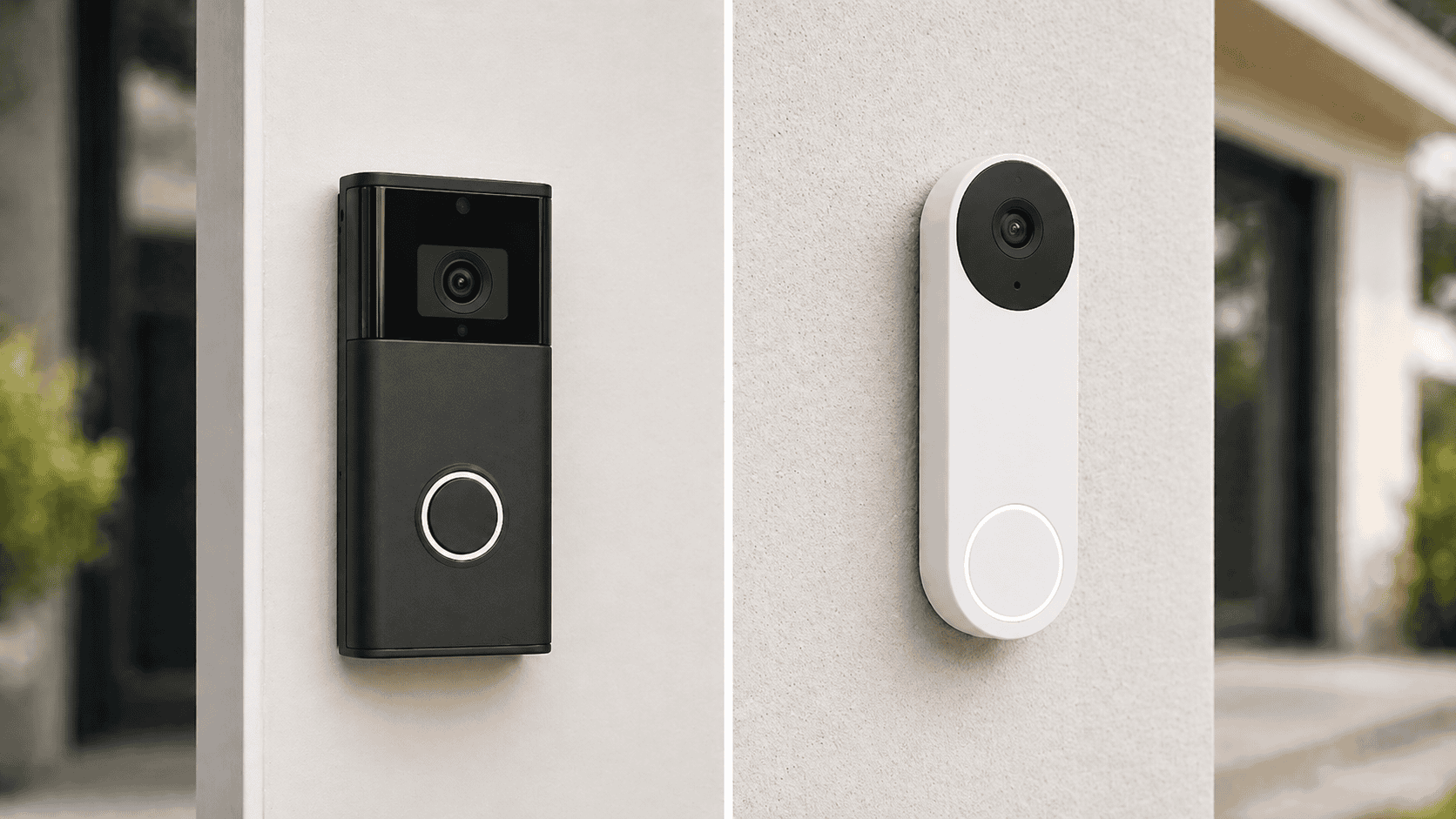
Ring and Google Nest are the two most recognized doorbell camera brands in North America, and they represent genuinely different philosophies about how a front-door camera should work. Ring is built around Amazon’s ecosystem, offers the widest lineup of models in the category, and prioritizes flexibility and breadth. Nest is built around Google Home, offers fewer models with deeper AI integration, and prioritizes detection accuracy and platform cohesion.
Neither is universally better. The right choice depends almost entirely on which smart home platform you use, whether your home has existing doorbell wiring, and how you feel about subscription costs. This comparison works through every meaningful dimension so you can reach the right answer for your specific situation.
The Cameras Being Compared
Both brands offer multiple models, so it is worth being explicit about which cameras this comparison covers. On the Ring side, the primary battery-powered model for most buyers is the Ring Battery Doorbell Plus at around $120, and the primary wired model is the Ring Wired Doorbell Pro (also sold as the Ring Video Doorbell Pro 2) at $249. On the Nest side, Google offers the Nest Doorbell Battery at $179.99 and the Nest Doorbell Wired (3rd Gen) at $140 to $180 depending on retailer. Where the comparison applies to both models in a brand’s lineup, that is noted; where it is specific to a particular model, the model is named.
Video Quality
Ring and Nest take different approaches to resolution and framing, and both decisions have practical consequences.
Ring’s current battery model, the Battery Doorbell Plus, records at 1536p in a head-to-toe aspect ratio. The Ring Wired Doorbell Pro records at 1536p in a 1:1 square aspect ratio, and the newer Ring Wired Doorbell Pro 3rd Gen reaches 4K. Nest’s battery model records at 960 x 1280 — a lower pixel count than Ring’s equivalent — while the Nest Doorbell Wired 3rd Gen shoots 2K HDR, matching or exceeding Ring’s mid-tier wired model.
In practical terms, both brands’ current battery doorbells produce footage that identifies faces clearly at typical speaking distances. The gap between Ring’s 1536p and Nest’s 960p becomes more visible when zooming in on footage or when subjects are further from the door. If you frequently want to identify people or read package labels at the edge of the frame, Ring’s higher resolution is a meaningful advantage for the battery models.
Where Nest compensates is HDR processing. The Nest Doorbell Wired 3rd Gen’s HDR handles backlit subjects — a common front-door challenge when afternoon sun sits behind a visitor — more cleanly than most Ring models in independent testing. Wirecutter’s 2026 evaluation specifically cited the Nest Wired 3rd Gen’s image processing as a standout.
Both brands use portrait-oriented frames that capture visitors from head to toe. Neither crops the visitor at the waist the way older 16:9 widescreen cameras do.
Edge: Ring for battery models on resolution. Nest for wired models on overall image processing.
AI Detection and Smart Alerts
This is the most important category for day-to-day usability, and Nest wins it clearly on the free tier.
Google Nest’s on-device AI — powered by Gemini in the 3rd Gen wired model — detects and classifies people, packages, vehicles, and animals without a subscription. Wirecutter’s 2026 real-world testing of the Nest Wired 3rd Gen found it never missed a detection event, which is a result they do not attribute to many cameras. False positive rates in windy conditions and with passing vehicles are consistently lower than Ring’s equivalent. Familiar Faces recognition, which sends personalized alerts when it identifies a specific person, is also available with a Google Home Premium subscription.
Ring’s detection on the free tier covers motion alerts and basic classification. Person-specific detection, package alerts, vehicle detection, animal detection, and the Bird’s Eye View aerial tracking all require an active Ring Protect subscription. Without paying, you get motion-triggered notifications that tell you something happened but not what. That is a meaningful gap for buyers who want useful alerts without a monthly fee.
With subscriptions active, Ring’s detection on its Pro models is strong — the radar-based 3D Motion Detection on the Wired Doorbell Pro is precise and customizable in ways that PIR-based detectors are not. But the subscription requirement to unlock those features changes the total cost calculation significantly.
Edge: Nest, and it is not close for free-tier buyers. Ring narrows the gap significantly with an active Protect subscription.
Subscription Costs
Both brands require subscriptions to store and review recorded video beyond a short free window. The structure and value differ.
Ring Protect Basic costs $4.99 per month per camera and provides 180 days of cloud video history, person and package detection, and rich notifications. The Ring Home plan at $9.99 per month covers unlimited Ring devices at one address. Without a subscription, Ring provides live view and real-time doorbell notifications only — no saved clips.
Google Home Premium, formerly Nest Aware, costs approximately $8 per month or $80 per year and covers all Nest cameras on one account. It extends event history from the free three hours to 30 days and unlocks Familiar Faces recognition and Gemini-powered features. Nest Aware Plus at $15 per month or $150 per year adds 60 days of history and 10 days of 24/7 continuous recording on compatible wired cameras.
The key differentiator is what you get for free. Nest provides three hours of rolling event history and full AI classification — people, packages, vehicles, animals — at no cost. Ring provides neither stored history nor AI classification without paying. For buyers who want meaningful camera functionality without a subscription, Nest’s free tier is substantially more useful.
Over two years with the per-camera subscription, Ring’s Basic plan adds $120 to total cost. Google Home Premium adds $192 over the same period but covers all Nest cameras. For single-camera households, Ring costs less over two years. For multi-camera setups, the math shifts in Nest’s favor.
Edge: Nest on free-tier value. Ring on per-camera cost for single-camera buyers.
Smart Home Ecosystem
This is the most straightforward dimension of the comparison, and it is the factor most likely to determine the right answer before any other consideration.
Ring is owned by Amazon. Its integration with Alexa and Echo devices is the deepest in the category. Live view surfaces automatically on Echo Show screens when the doorbell rings. Ring routines support extensive automation with Alexa. The Ring app is focused, fast, and rated well on both iOS and Android. If you use Echo devices, Ring cameras, or Ring Alarm, the platform cohesion is genuine and adds real value.
Nest is part of Google’s ecosystem. Live view surfaces automatically on Nest Hub and Nest Hub Max displays. Google Home Automations support over forty trigger conditions including doorbell presses, and integration with other Google Home devices — thermostats, locks, lights — is deep and well-implemented. If you use Google Home, Nest speakers, or Nest displays, the integration is similarly cohesive.
Neither brand supports Apple HomeKit. If HomeKit is a requirement, both Ring and Nest are disqualified and the Arlo Video Doorbell 2K is the only mainstream option that qualifies.
Edge: Ring for Alexa households. Nest for Google Home households. Neither for HomeKit users.
Privacy
Both companies have documented histories of sharing user data with law enforcement, and both have faced public scrutiny for their practices. The specifics differ.
Ring operated a partnership program with police departments through its Neighbors app that allowed law enforcement to request doorbell footage without a warrant in certain circumstances. Ring ended the direct data-sharing program in 2023 following Congressional scrutiny, but has retained the ability to share footage in emergency situations involving imminent danger. Ring footage has also been accessed by Amazon employees in ways that generated significant press coverage in 2019.
Google Nest has shared footage with law enforcement in emergency situations without user consent, citing safety justifications. Google’s privacy policy is generally considered more transparent than Ring’s by consumer advocates, and Nest’s data handling in Europe under GDPR receives better compliance reviews.
Neither company has a clean record. For buyers who prioritize privacy and want footage that stays off cloud servers by default, neither Ring nor Nest is the right choice — Eufy’s local-first model or Reolink’s microSD storage are better-aligned alternatives. For buyers choosing between the two brands specifically, Nest’s privacy practices are marginally more transparent, though the practical difference for most users is small.
Edge: Nest, marginally.
Installation and Power
Ring offers eight doorbell models spanning battery, wired, and plug-in configurations at a wide range of price points. The entry-level Ring Video Doorbell HD starts around $60. This breadth means Ring has a viable option for virtually any installation scenario.
Nest offers two configurations: battery and wired. Both are the same hardware in different power arrangements. There is no plug-in adapter option, and the wired model requires 8 to 24V AC existing doorbell wiring. The lineup is simpler, which also means less flexibility for buyers with unusual installation requirements.
Ring’s battery models have longer claimed battery life than the Nest Doorbell Battery. Ring Battery Doorbell Plus is rated for six to twelve months depending on traffic; the Nest Doorbell Battery is rated for up to six months but typically performs closer to two to three months in real-world testing on active doors. For buyers who find recharging inconvenient, this gap matters.
Both brands offer simple app-guided installation that most homeowners complete without professional help. Wired installation for either brand adds fifteen to thirty minutes of additional time for connecting low-voltage wires.
Edge: Ring on lineup breadth and battery longevity.
App Experience
The Ring app is purpose-built for security monitoring. Its home screen gives a quick overview of all connected cameras, notifications are fast and informative, and the interface is consistent across iOS and Android. Android ratings for the Ring app are strong — a meaningful differentiator compared to Arlo’s Android experience.
The Google Home app manages doorbells alongside thermostats, locks, speakers, and all other Nest and Google Home devices. It is a more complex application that serves a broader function. Live view through Google Home runs three to five seconds slower than Ring’s app in multiple independent comparisons, which can make a real-time conversation with a visitor at the door feel slightly stilted. For reviewing stored footage and managing alerts, the Google Home app performs well. For immediate live response, Ring’s app is faster.
Edge: Ring on live view speed and Android experience. Nest on ecosystem breadth within the app.
Price Comparison
| Model | Price | Subscription |
|---|---|---|
| Ring Battery Doorbell Plus | ~$120 | $4.99/mo per camera |
| Ring Wired Doorbell Pro (2nd Gen) | $249 | $4.99/mo per camera |
| Nest Doorbell Battery | $179.99 | $8/mo all cameras |
| Nest Doorbell Wired (3rd Gen) | ~$140–180 | $8/mo all cameras |
For a single battery doorbell with subscription, Ring costs approximately $300 over two years ($120 hardware + $180 subscription). Nest costs approximately $372 ($180 hardware + $192 subscription). Ring wins on two-year total cost for single-camera households. For buyers with multiple cameras, Nest’s per-account pricing becomes more competitive.
The Verdict by Buyer Type
Choose Ring if you use Amazon Alexa or Echo devices, want the widest selection of models and price points, need longer battery life, prefer a faster live view response in the app, or want to minimize subscription costs on a single camera. Ring is also the better choice for buyers who already have other Ring cameras or a Ring Alarm system.
Choose Nest if you use Google Home, Nest speakers, or Nest Hub displays, prioritize AI detection accuracy over everything else, want meaningful free-tier functionality without paying a monthly fee, have existing doorbell wiring and want a wired model with 2K HDR, or are a multi-camera household where a per-account subscription covers everything.
Choose neither if you need Apple HomeKit compatibility — Arlo is the only mainstream option that supports it. And if subscription-free operation with local storage is the primary requirement, Eufy and Reolink serve that buyer better than either Ring or Nest.
