
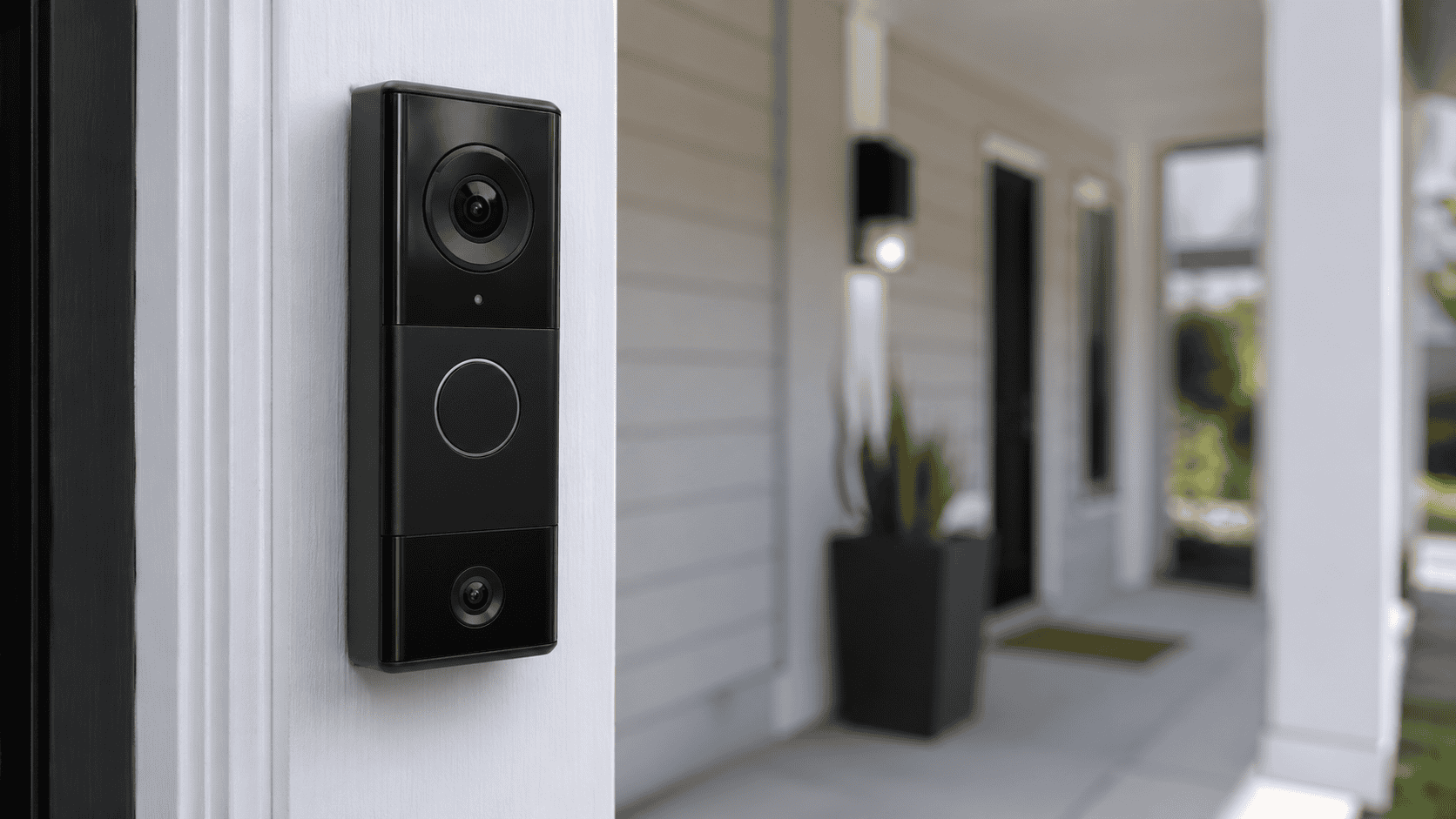
The Eufy Video Doorbell E340 does something no other mainstream doorbell camera does: it puts two cameras on your front door and charges you nothing beyond the purchase price to use them. The main camera watches for visitors. The second camera, angled downward, watches for packages. Both record in high resolution, both have color night vision, and all the footage stays locally on the device without a cloud subscription. For buyers who have grown tired of monthly fees, the E340 makes a compelling case.
It is also big, chunky, and noticeably bulkier than competing models. It has no Apple HomeKit support. Its motion detection accuracy has drawn mixed feedback in owner testing. And Eufy’s parent company Anker has a documented privacy controversy that any buyer considering this camera should understand before purchasing. This review covers all of it.
A Note on the Dual Doorbell Lineup
Eufy has released multiple dual-camera doorbells, and the naming creates confusion worth clearing up. The Video Doorbell Dual S330 was the original, released at a high price with a mandatory HomeBase hub required for operation. The E340 is its successor — similar dual-camera hardware but redesigned to work standalone without a HomeBase, sold at a significantly lower price, and with a removable battery replacing the S330’s fixed unit. The S330 remains available but the E340 is the current recommended model in this category. This review covers the E340.
Specs at a Glance
The Eufy E340 uses two cameras: a primary forward-facing unit at 2048 x 1536 (2K) resolution and a secondary downward-angled camera at 1600 x 1200. Both have color night vision. The dual-light system places LEDs at the top and bottom of the unit with a stated night vision range of up to 16 feet. The removable 6500mAh battery charges via USB-C in approximately five hours and is rated for up to four months between charges. The unit supports wired installation via existing 16 to 24V AC doorbell wiring for continuous charging. Storage is 8GB built-in eMMC with no microSD slot, estimated at 90 days of event-based recording at normal usage. Optional compatibility with HomeBase 2 or HomeBase 3 expands storage to 16GB or up to 16TB respectively. Wi-Fi is 2.4GHz only. The camera supports Alexa and Google Assistant but not Apple HomeKit. IP rating is not specified by Eufy for the E340. The unit is available in black.
Design and Build
The E340 is a large camera. Multiple reviewers across Pocket-lint, SafeWise, and Home Depot owner reviews consistently describe it as chunky, blocky, and more visually prominent than alternatives from Ring, Arlo, or Nest. The size is a direct consequence of what is inside: two camera modules, top and bottom LED arrays, and a removable 6500mAh battery pack. If you accept the trade-off, the bulk makes sense. If front door aesthetics are a priority, the Nest Doorbell Battery or Arlo 2K will suit you better.
The matte black finish is the only color option, which limits exterior match flexibility. Eufy includes a straight mounting plate and a 15-degree wedge in the box, along with all required screws and a positioning card that shows exactly where the holes need to go. Trusted Reviews noted installation as straightforward, and the app-guided setup process is well regarded across multiple independent reviews.
The removable battery is a meaningful design advantage over the Nest Doorbell Battery and the Arlo Video Doorbell 2K, both of which require removing the entire unit to recharge. With the E340, a key-style release pops off the battery pack while the camera body stays mounted. Keeping a spare battery on hand eliminates downtime entirely — Eufy sells additional packs separately and includes the release key in the box.
One confirmed limitation: Eufy has not published an IP weather resistance rating for the E340. Competing cameras including the Arlo 2K (IP65), the Google Nest Doorbell Battery (IP54), and the Ring Battery Doorbell Plus (IPX5) all carry verified weather ratings. The E340’s outdoor durability in sustained rain has not been independently confirmed to the same standard, which is worth knowing for installations with direct rain exposure.
The Dual Camera System
The dual-camera design is the E340’s defining feature and primary reason to choose it over any single-camera alternative. Understanding how the two cameras work together in practice matters more than the specs alone.
The primary camera faces forward at eye level and captures standard doorbell footage: approaching visitors, faces at speaking distance, and the porch environment. The secondary camera angles downward and covers the area directly in front of the door — the blind spot that single-camera doorbells miss entirely. Packages set down at the threshold, deliveries left close to the door, and objects placed immediately in front of the step all appear in the secondary camera’s view even when they are invisible to the primary.
The combined view displays in the Eufy Security app in two formats: stacked vertically with the primary image above and the secondary below, or as a picture-in-picture with the secondary frame inset over the primary. Both options are useful depending on what you are looking at. Pocket-lint’s reviewer found Delivery Guard — the feature that specifically monitors the downward camera for package arrivals and removals — to be the standout capability of the entire camera. SafeWise called it practically porch pirate-proof in sustained testing.
Trusted Reviews noted that smaller packages were sometimes missed by the package detection AI while larger boxes were reliably identified. This is consistent with the category more broadly — package detection across all brands performs better on standard courier boxes than on envelopes, padded bags, or unusually shaped deliveries. For typical courier and e-commerce deliveries, the system works well.
Video Quality
The primary camera’s 2K resolution produces sharp, clear footage in daylight. Faces are identifiable at typical doorbell distances, and the image holds up when zoomed in to read package labels or identify details. HDR processing is included and handles outdoor contrast adequately, though independent testing noted dynamic range performance falls slightly below the Nest Doorbell Wired 3rd Gen and the Arlo 2K in high-contrast conditions with bright backgrounds.
The secondary camera at 1600 x 1200 is lower resolution than the primary but produces footage that is clear and useful for its intended purpose. At close range to the door threshold, it is more than sufficient for identifying packages, reading labels, and confirming whether something has been picked up.
Color night vision via the dual-light LED system performs well at close range. The 16-foot stated range is ambitious; in real-world owner testing, consistent color clarity holds to approximately seven to ten feet, with quality degrading beyond that range. The night vision is genuinely color — not the muted colorization that some cameras apply as a post-processing effect — and it outperforms infrared-only competitors on identifying clothing colors, vehicle markings, and other after-dark details that matter for identification. Homes and Gardens tested the E340 over five months and described nighttime visibility as a clear improvement over standard IR cameras.
Motion Detection
The E340’s motion detection produces mixed results in owner feedback, which is the most honest characterization of the data available. Detection accuracy in controlled testing from Trusted Reviews and Homes and Gardens is positive. Owner reviews on Home Depot and Amazon include a meaningful minority reporting missed events — visitors not triggering alerts, packages arriving undetected — and some difficulty tuning sensitivity settings to an acceptable level without generating excessive false positives.
Person-only detection mode filters alerts to confirmed human motion and reduces nuisance notifications from vehicles and environmental movement. Activity zones let you define specific detection areas through the app and exclude the street or a neighbor’s walkway. Both work as described in controlled conditions; the inconsistency appears in high-traffic or edge-condition scenarios where the detection AI is more likely to make judgment errors.
One confirmed hardware note: the E340 does not include the radar-based motion detection present in the earlier S330 model. Standard PIR-based detection is used instead. Radar detection provides meaningfully more precise motion mapping and lower false positive rates — its absence in the E340 is a step back from the S330 in this specific area, and worth knowing if motion detection accuracy is the primary purchase criterion.
Facial recognition is included and runs on-device without a subscription. The system learns faces through the Eufy Security app and delivers personalized alerts when recognized individuals appear. Because the E340 functions without a HomeBase by default, the facial recognition model must be trained from scratch on the device itself rather than inheriting data from a shared HomeBase. If you own other Eufy cameras connected to a HomeBase, connecting the E340 to it allows sharing the facial recognition database across devices.
Storage
The 8GB of built-in eMMC storage is the E340’s most practical privacy advantage. Footage stays on the device, not in Eufy’s cloud, unless you specifically opt into cloud backup. The 8GB capacity handles approximately 90 days of event-based recording at normal usage, which Eufy defines as 30 events of 20 seconds each per day. Higher-traffic doors will fill the storage faster; Eufy estimates about 58 percent battery consumption over 30 days in typical conditions, suggesting similar event volume assumptions.
There is no microSD card slot for expanding onboard storage. The only expansion path is connecting to a HomeBase 2 or HomeBase 3, which provides 16GB onboard or up to 16TB via external drive connected to the HomeBase 3. For buyers who want a larger local storage archive without HomeBase, this is a genuine limitation compared to Reolink, which supports up to 256GB via microSD with no hub required.
Cloud storage plans are available optionally and are not required for any core feature.
The Privacy Context
Any review of a Eufy camera in 2026 that omits the company’s 2022 privacy controversy is doing the reader a disservice. Eufy and its parent company Anker were found in late 2022 to be uploading facial recognition data and camera thumbnails to cloud servers despite marketing that explicitly described all footage as stored locally and never sent to the cloud. The issue was disclosed by security researcher Paul Moore and reported by The Verge, and it generated significant coverage.
Eufy’s response acknowledged the issue, committed to improved transparency, and made changes to data handling practices. The company updated its privacy policies, modified push notification behavior to stop thumbnail uploads by default, and improved encryption practices. Consumer Reports rated the E340 highly for data security in 2026 testing, which suggests the post-controversy changes have been implemented credibly.
The honest position is that Eufy’s local-storage model has genuine privacy advantages over cloud-first competitors like Ring and Nest. The 2022 incident is real, documented, and should be weighed by buyers for whom privacy is a primary concern. It should not be automatically disqualifying in 2026 given the documented remediation — but buyers who need absolute confidence in a manufacturer’s privacy claims may prefer the Reolink or Lorex local-storage alternatives, neither of which has a comparable controversy in their history.
Installation
Installation is battery-powered or wired, and the process is well-documented through the Eufy Security app. The positioning card included in the box marks exactly where to drill, removing one of the most common installation errors. Homes and Gardens completed the full install in approximately twenty minutes from unboxing to live view. Trusted Reviews described the process as straightforward.
Wired installation connects to existing doorbell wiring for trickle charging, which keeps the battery maintained without ever needing removal. When wired with a compatible transformer, the existing chime activates on doorbell presses. In battery-only mode, chime options include a Google Assistant device, an Alexa device, the optional Eufy MiniBase Chime, or a HomeBase unit — none of which are included in the standard box.
The 2.4GHz-only Wi-Fi is a consistent limitation across the Eufy doorbell lineup and shared with the Arlo 2K. In most home environments this creates no connectivity issues. In dense multi-unit buildings or homes with heavily congested 2.4GHz bands, it is worth testing signal strength at the front door before committing.
How It Compares
Against the Ring Battery Doorbell Plus, the E340 has a dual-camera system that Ring does not match, color night vision where Ring has infrared only, local storage with no subscription, and a removable battery. Ring has better motion detection consistency, a more polished app, a lighter and slimmer design, and deeper ecosystem integration.
Against the Google Nest Doorbell Battery, the E340 has higher resolution, color night vision, dual cameras, local storage, and no mandatory subscription. The Nest has superior AI detection accuracy, better dynamic range, a slimmer design, and deeper Google Home integration.
Against the Arlo Video Doorbell 2K, the E340 has local storage with no subscription, a removable battery, and dual cameras. The Arlo has Apple HomeKit support, a wider field of view, a stronger weather rating, a built-in siren, and better Android app ratings.
The Bottom Line
The Eufy Video Doorbell E340 is the right camera for buyers who want dual-camera package monitoring and genuinely subscription-free local storage in a single device. The Delivery Guard feature is the most practically useful package-detection implementation in the category, and the removable battery is a better design than the built-in non-removable packs in competing models. The no-subscription local storage keeps total cost of ownership genuinely low over time.
The bulk, the missing weather rating, the weaker radar-less motion detection relative to the S330, the 2.4GHz-only limitation, and the 2022 privacy history are real factors that the right buyer will weigh clearly. For buyers who prioritize package security, local storage, and freedom from monthly fees above all else, the E340 is the strongest option in the category in 2026.
