
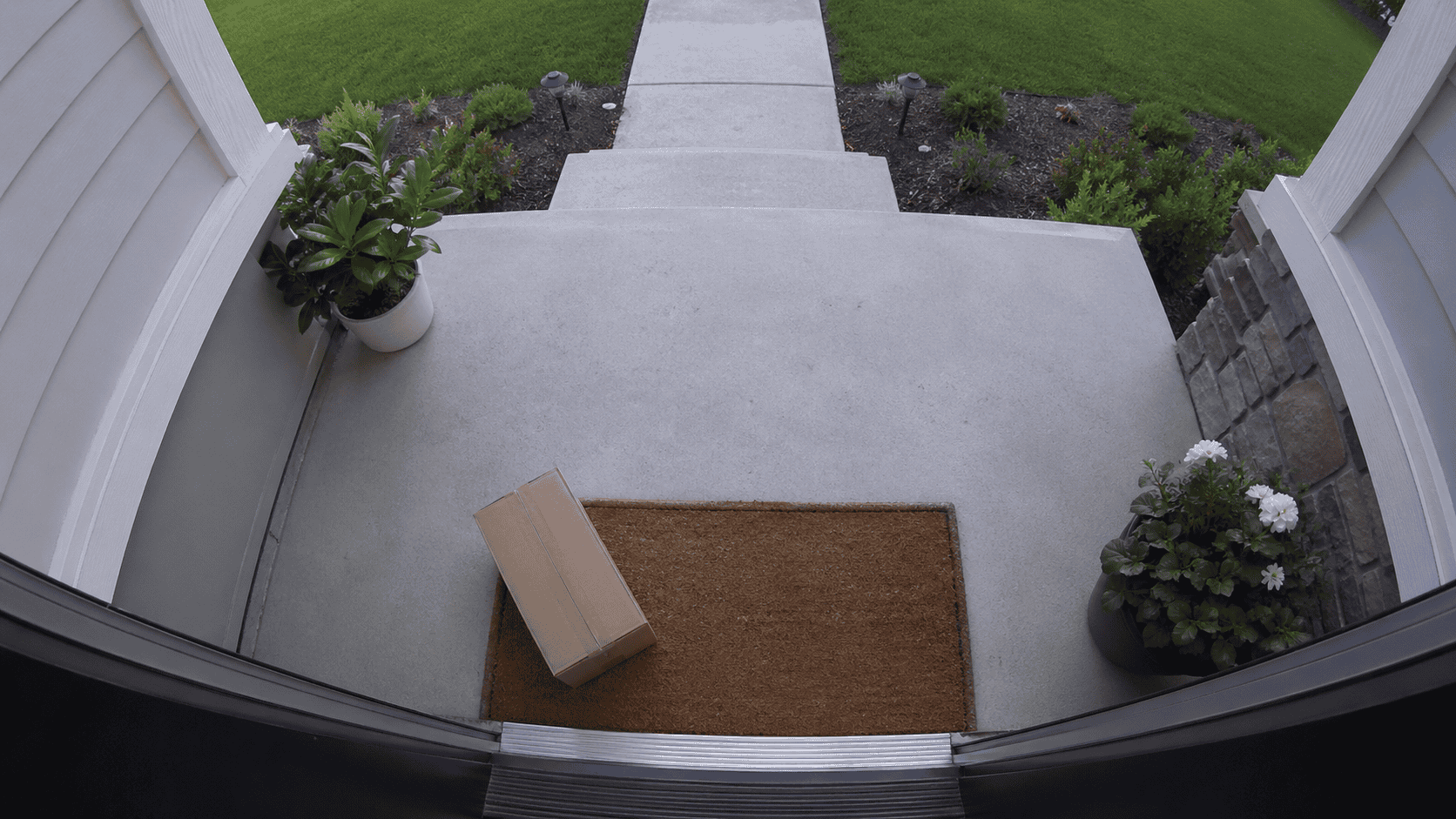
Field of view is one of the most important specifications on a doorbell camera and one of the least understood. Most buyers glance at the degree number in the spec sheet, assume bigger is better, and move on. The reality is more nuanced — and getting it wrong means a camera that misses the exact things you need it to see.
This guide explains what field of view actually measures, why the single number in most spec sheets does not tell the whole story, how FOV interacts with aspect ratio and resolution, and what to look for based on your specific front-door setup.
What Field of View Means
Field of view refers to the extent of the area a camera can see at any given moment. It is measured in degrees, representing the angle of a cone of vision extending outward from the camera lens. A camera with a 90-degree field of view sees a narrower slice of the world than one with a 160-degree field of view.
The practical way to think about it: stand at your front door and spread your arms out to your sides. The angle between your fingertips represents roughly your peripheral vision at about 180 degrees total. A doorbell camera with a 160-degree field of view captures most of that spread. A camera at 120 degrees captures about two-thirds of it. A camera at 90 degrees — closer to what you see when looking straight ahead — misses the sides of the porch entirely.
For a doorbell camera specifically, field of view determines what approaches to your front door you can actually see. A narrow FOV captures the immediate area in front of the lens clearly but misses visitors approaching from the side, vehicles pulling up at an angle, and activity at the edges of the porch. A wide FOV captures more of the surrounding area but can introduce distortion at the edges and may reduce the apparent size of subjects in the center.
The Problem with Diagonal FOV
Here is where most spec sheets mislead buyers. When a camera lists a field of view — say, 180 degrees — that number almost always refers to the diagonal field of view, measured corner to corner across the lens. The horizontal field of view, which determines how far left and right the camera sees, and the vertical field of view, which determines how much top-to-bottom coverage the camera provides, are both smaller than the diagonal number.
The Arlo Video Doorbell 2K is a useful real-world example. It is marketed with a 180-degree diagonal field of view. In community testing, users found the actual horizontal field of view to be closer to 160 degrees, with the vertical coverage being smaller still. The 180-degree claim is technically accurate for the diagonal measurement — the distance between the top-left and bottom-right corners of the frame — but it overstates what most buyers are imagining when they read the spec.
This distinction matters because horizontal and vertical coverage serve different security purposes. Horizontal coverage determines how much of the sides of your porch and approach path you see. Vertical coverage determines whether you can simultaneously see a visitor’s face and a package at their feet. A camera with wide horizontal coverage but limited vertical coverage might show you the full width of your front steps while cropping out packages on the ground. A camera with strong vertical coverage in a tall aspect ratio might show you head to toe clearly while missing activity to the far left and right.
When comparing cameras, look for both horizontal and vertical FOV figures where available. When only one number is listed and the manufacturer does not specify which measurement it represents, assume it is diagonal.
How Aspect Ratio and FOV Work Together
Field of view and aspect ratio are two separate specifications that combine to determine what you actually see in the camera’s frame. Understanding both together is more useful than either alone.
Aspect ratio describes the shape of the video frame — the proportional relationship between its width and height. A 16:9 widescreen ratio produces a wide, horizontal rectangle. A 1:1 square ratio produces equal horizontal and vertical coverage. A 3:4 portrait ratio produces a taller frame that emphasizes vertical coverage.
The same field of view number produces very different practical coverage depending on the aspect ratio it is delivered in. A 145-degree diagonal FOV in a 16:9 widescreen format captures a wide horizontal area but compresses the vertical — visitors appear from roughly the chest up, and packages at the base of the door fall outside the frame. The same 145-degree diagonal FOV delivered in a 3:4 portrait format captures less horizontal width but sees the visitor from head to toe, including ground-level deliveries.
This is why the Google Nest Doorbell Battery, despite its lower resolution of 960 x 1280, captures a more complete view of a visitor and their packages than many higher-resolution widescreen cameras. Its 3:4 portrait aspect ratio uses the available pixels to show more vertical content rather than more horizontal content. And it is why the shift away from 16:9 widescreen in the doorbell camera category over the past three years has been a genuine improvement in practical usability, not just a cosmetic change.
For most front-door installations, a square or portrait aspect ratio is more useful than widescreen. You see one visitor at a time, and seeing them fully — face and packages together — matters more than seeing a wider slice of the porch.
FOV Ranges in Practice
Doorbell cameras in 2026 span a field of view range from roughly 120 degrees to 180 degrees diagonal. Here is what each range actually delivers in practice.
Cameras in the 120 to 135-degree range provide focused coverage of the immediate door area. Faces at normal speaking distance are clear and detailed, and the narrower angle reduces the wide-angle distortion that affects fisheye lenses. The trade-off is that activity at the edges of the porch — a visitor approaching from the side, a vehicle at the edge of the driveway — falls outside the frame.
Cameras in the 145 to 160-degree range are the most common among mainstream doorbell cameras and represent a reasonable balance between coverage breadth and image quality. This range captures most approach paths to a typical residential front door without significant edge distortion, and faces remain identifiable at normal distances without the fisheye warping that appears at the widest angles.
Cameras in the 165 to 180-degree range provide the widest coverage available in the doorbell category. The Arlo Video Doorbell 2K, Reolink Video Doorbell WiFi, and a handful of others operate at this end of the range. The trade-off is fisheye lens distortion — objects and people at the edges of the frame curve outward in a way that is visually noticeable and slightly reduces the perceived detail of peripheral subjects. For most front-door use cases where the subject is standing centrally in front of the camera, this distortion is not practically significant. For installations where wide-angle edge coverage matters, it is worth knowing.
Mounting Height and FOV
The camera’s mounting height changes what the field of view actually captures, independent of the lens specification. A camera mounted at eye level — roughly 48 to 54 inches from the ground — points roughly horizontally and captures the approach path at face height with some ground coverage depending on vertical FOV. A camera mounted above eye level, such as at door frame height of 80 to 84 inches, points slightly downward and sees more of the ground directly in front of the door but less of the approach path at distance.
The recommended mounting height for most doorbell cameras is 48 inches, or roughly chest height. At this height, the camera captures visitors’ faces clearly without requiring them to look up or crouch, and the vertical coverage of most modern square or portrait-format cameras reaches both face height and ground level simultaneously.
Mounting higher than 48 inches improves package detection — the camera looks more directly at the doorstep — but reduces face identification quality at distance because visitors appear smaller in the frame and at a steeper angle. Some cameras address this with a downward-angled mounting wedge included in the box. The Eufy E340 takes a structural approach with its second downward-facing camera dedicated to package detection, eliminating the trade-off entirely by using two lenses for two separate purposes.
FOV and False Alerts
A wider field of view captures more of the world, which means more potential motion triggers. A doorbell camera with a 175-degree FOV pointed at a busy street will see — and potentially alert on — every vehicle that passes, every pedestrian on the sidewalk, and every tree that sways in the wind. This is manageable with good motion zone customization, but it places a higher configuration burden on the buyer.
Motion zones allow you to draw a detection area over the live view and tell the camera to ignore activity outside that boundary. A doorbell with a 180-degree FOV and strong motion zone tools can be as precise in its alerting as a camera with a narrower lens — but it requires setup time. A camera with a narrower 130-degree lens pointed at the porch rather than the street may need no configuration at all to deliver an acceptable alert rate.
This trade-off matters more in urban and suburban settings with visible street traffic than in rural areas or properties with set-back approaches. If your front door faces a busy road or a shared parking area, a wider FOV increases the configuration work required to keep alerts useful.
What to Look for When Buying
For a typical residential front door, a camera with a diagonal field of view between 145 and 160 degrees, delivered in a square or portrait aspect ratio, covers the most relevant area without requiring extensive motion zone configuration. This is the sweet spot for most buyers and where the strongest cameras in the 2026 market cluster.
For wide driveway or multi-car approach coverage, a 160 to 180-degree horizontal field of view is worth the fisheye trade-off. The Reolink Video Doorbell WiFi at 180 degrees diagonal is the strongest option here, paired with its 5-megapixel resolution that partially compensates for the distortion at the edges.
For package detection without a wide-angle lens, the Eufy E340’s dual-camera approach is the most elegant solution — a dedicated downward-facing camera covers the doorstep while the primary camera covers the approach at the optimal angle for face identification.
For installations where the camera must be angled to cover an off-center approach path, verify that your chosen camera includes an angled mounting wedge. Ring includes a corner kit with its Wired Doorbell Pro. Arlo includes a wedge with the Video Doorbell 2K. Cameras that omit this accessory can often be fitted with third-party wedge mounts, but the compatibility needs to be confirmed before purchasing.
A Note on Manufacturer FOV Claims
Field of view specifications are not always measured or reported consistently across manufacturers. Some list diagonal FOV, some list horizontal FOV, and some simply say “field of view” without specifying which axis they measured. The Arlo community forum example cited above — where the stated 180-degree FOV turned out to be closer to 160 degrees horizontal in real-world testing — illustrates how the same hardware can produce different numbers depending on how the measurement is taken.
When evaluating a camera’s FOV, look for independent real-world tests from sources like Wirecutter, PCMag, or Security.org rather than relying exclusively on manufacturer spec sheets. Where diagonal, horizontal, and vertical figures are all available, the horizontal and vertical numbers are more practically useful for predicting what the camera will cover than the diagonal alone.
